
When working at height, how you manage risks determines how safe a working environment actually is. In practice, I regularly see confusion between fall prevention and fall protection, even though this distinction guides the choices you make in design, implementation and management.
The difference is simple: fall prevention prevents someone from falling, fall protection limits the consequences if it does happen. So the question is not which is better, but what is appropriate in your situation. If you would like personal advice, feel free to contact me.
The difference translated into practice
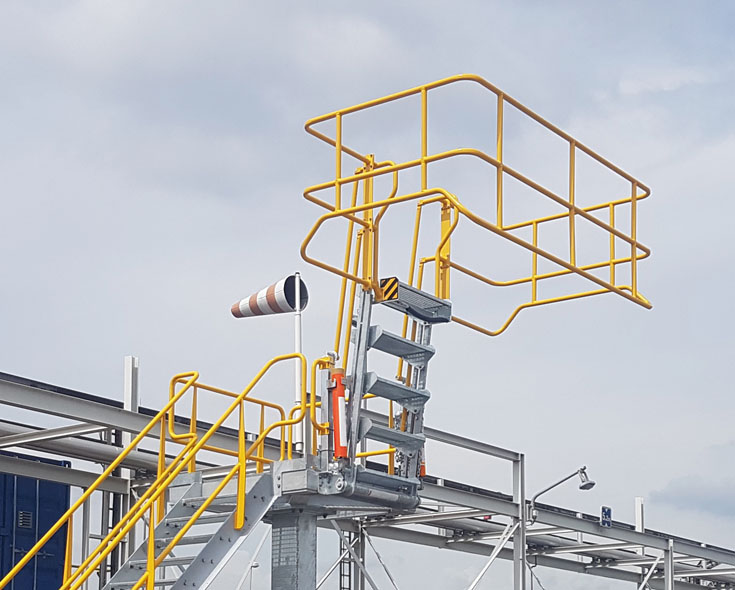
Fall prevention focuses on the structural elimination of fall hazards. Physical adjustments to the workplace prevent someone from getting into a high-risk situation. Examples include fixed railings, guards and landings that create a safe work zone.
Fall protection is applied when this is not entirely possible. The risk remains, but is controlled with personal protective equipment such as harnesses and lifelines. These solutions require correct use and additional organisational measures.
Legal framework as the basis for your choice
The order in which you choose measures is laid down in Directive 89/391/EEC and translated in the Netherlands into the Working Conditions Act. This hierarchy is leading in every situation:
- Eliminate danger
- Applying collective measures
- Deploying personal protection
These steps are the starting point for designing safe workplaces and installations.
When do you choose fall prevention?
Fall prevention is suitable in situations where you can make structural adjustments to the working environment and the work is carried out on a regular basis. Examples include maintenance on the roofs of distribution centres, technical installations on commercial buildings or access to machinery in production environments. In these situations, fixed or modular solutions are often used, such as safety barriers and mobile access platforms, which become an integral part of the workplace.
Fall prevention also provides clarity in locations where several people work or where there are changing users with access. Everyone works within the same safe framework, without depending on individual actions.
EngiFlow specialises in industrial fall prevention and installs, for example, safety barriers and mobile platforms in sectors such as industry, logistics and non-residential construction. These solutions are used, amongst other things, on maintenance platforms, loading and unloading areas, and technical installations. In practice, you’ll find that these types of applications are particularly effective in companies where safety must be an integral part of day-to-day processes. On our website, you’ll find various projects in which these solutions have been specifically developed and implemented in different working environments.
When do you choose fall protection?
Fall protection comes into play when it is not possible to completely eliminate the risk of falling with collective measures. This is the case, for example, when working on complex steel structures, installations at height where there is no room for permanent facilities or temporary work such as inspections and assembly work.
Fall protection can also be an appropriate solution in situations where flexibility is needed, for example for changing workplaces or short-term projects. Think of mechanics working in different locations or carrying out maintenance in hard-to-reach places.
In these cases, it is important that use, training and control are well organised. The effectiveness of fall protection is directly related to how carefully these preconditions are organised.
Finding the right balance
The choice between fall prevention and fall protection does not arise from one factor, but from the combination of use, environment and organisation. By getting these aspects in focus beforehand, it becomes clear which solution is most logical and effective in your situation.
- Frequency of use: the more frequently a workplace is used, the more logical a structural solution becomes
- Duration of work: long-term or recurring work requires different measures than occasional tasks
- Technical feasibility: the physical environment determines which solutions are possible
- User group: the larger and more varied the group, the more important predictable and fixed solutions become
- Organisation and management: the extent to which training, supervision and correct use can be secured
Frequently asked questions
Is fall prevention always mandatory?
By law, you must first investigate whether fall hazards can be eliminated or solved collectively. Only if that is not possible should you switch to personal protection.
Is fall protection sufficient for inspection work?
This is possible, provided the work is short-term and the right resources and procedures are in place. It is important to assess whether this is feasible in practice.
When is a fixed solution cost-effective?
With recurring operations or intensive use, a fixed facility often pays for itself, both in safety and in ease of use and efficiency.
How do I start making the right choice?
Start by mapping out operations, frequency and users. From there, you can determine which step within the hierarchy is most appropriate and how to translate this into a practical solution.